

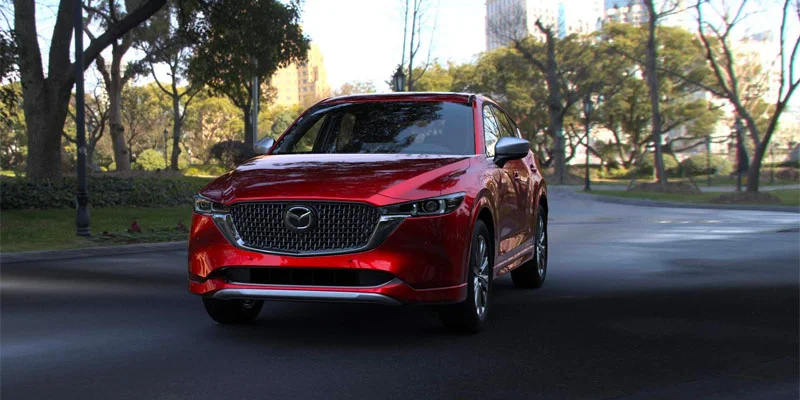
Deciding between the CX-5 and CX-50 means weighing two of the top-rated compact SUVs on the market. Here’s a clear breakdown of how they compare so you can decide which one suits your needs better before heading to your local Mazda dealership.
Powertrain
The Mazda CX-5 and CX-50 both come with two engine choices: a standard 2.5-liter four-cylinder with 187 horsepower and a turbocharged version of the same engine that gives you 227 horsepower with regular gas or up to 256 with premium. The turbo engines feel strong and responsive, especially at lower speeds, so you don’t need to rev them hard to get going quickly. All-wheel drive is standard, along with a smooth-shifting six-speed automatic that you can shift manually.
As for fuel economy, non-turbo CX-5s get up to 26 mpg in the city and 30 on the highway, while their CX-50 counterparts get 25 mpg city and 31 mpg highway. Turbo models are a bit thirstier: 22 mpg city/27 mpg highway for the CX-5 and 23 mpg city/29 mpg highway for the CX-50. The CX-50 also has a hybrid version (unlike the CX-5), which makes 219 horsepower and gets an impressive 38 mpg combined.
Ride Quality
The CX-50 uses a torsion beam rear suspension, which helps increase towing capacity (up to 1500 pounds more than the CX-5) and generally runs quieter than a multi-link setup. The CX-5, on the other hand, uses an independent rear suspension, which soaks up bumps a bit more gracefully on uneven roads. That said, Mazda’s tuning is well done on both models that you’d have to really focus to tell the difference.
Looks and Off-Road Readiness
While the CX-5 is clean-cut and city-smart, the CX-50 is more aggressive. It’s lower, longer, meaner looking than the CX-5, and thanks to 8.3 inches of ground clearance (vs. 7.6 inches in the CX-5), it’ll clear rocks and ruts with far less chance of leaving its underbits behind.
Passenger and Cargo Space
Inside, space differences are subtle. The CX-5 edges ahead in hip and shoulder room, but the overall passenger comfort should feel similar between the two. Cargo-wise, the CX-50 squeezes out a bit more usable volume (both can handle around nine carry-on bags behind the rear seats).
One small difference: the rear seats fold differently. The CX-5 uses a 40-20-40 split, which is great for flexibility, like carrying long items while keeping two seats usable. The CX-50 goes with a simpler 60-40 split.
The best way to see the differences between these two SUVs is to experience them firsthand. Reach out to Mazda of Wooster in Wooster, OH, and schedule your test drive.
Connect with us


- September 2026
- August 2026
- July 2026
- June 2026
- May 2026
- April 2026
- March 2026
- September 2025
- August 2025
- July 2025
- June 2025
- May 2025
- April 2025
- March 2025
- January 2025
- December 2024
- November 2024
- October 2024
- September 2024
- August 2024
- November 2023
- October 2023
- September 2023
- August 2023
- July 2023
- June 2023
- May 2023
- April 2023
- March 2023
- February 2023
- January 2023
- December 2022
- November 2022
- October 2022
- September 2022
- August 2022
- July 2022
- June 2022
Archives
- 2023 Model Year
- Auto Maintenance
- Battery Replacement
- Brake Repair
- Brake Service
- Car Financing Wooster, OH
- Car Repair
- Catalytic Converter in Wooster, OH
- Coffee Shops near Wooster
- CX-5
- Fall Activities
- Family Dining
- Local Coffee Shops
- Mazda CX-30
- Mazda CX-30
- Mazda CX-5
- Mazda CX-50
- Mazda CX-70
- Mazda CX-9
- Mazda CX-90
- Mazda Dealer Wooster, OH
- Mazda Financing
- Mazda of Wooster
- Mazda Service
- Mazda3
- Model Comparison
- Museums Wooster, OH
- New Mazda Model Features
- Pizza Places
- Pizza Restaurants
- Pre-Owned Mazda
- Pre-Owned Mazda Models
- Schedule Brake Service
- Things to Do in Wooster, OH
- Transmission Repair
- Trip Ideas near Wooster
- Uncategorized
- Wooster, OH